How to remember hundreds of passwords without writing them down

PASSWORD squareIf you’re like me you have a ga-jillion internet accounts.  Multiple email addresses, dozens of app or social media accounts. You want to keep your accounts secure so you don’t get hacked but there doesn’t seem like an easy way to do it. You either need to have the same password for every site or have a different password for every site.

Same Password

If you use the same password once a hacker accesses one of your accounts they can easily log into your other accounts. This is a nightmare scenario, especially if a hacker gets access to your shopping or banking accounts.  Perhaps if you use a really complex password this strategy is acceptable. One of the better ways to do this is with mnemonic passwords. Josette Dehaney covers mnemonic passwords nicely in her blog. Here’s an example of a mnemonic password:

     In 2013 I will take the opportunity every Sunday to relax, smile = !2013!wttOeS2R:-)

Different Password

If you use a different password for each site/app you quickly realize that there are too many passwords that you need to remember and you have to write them down. Once you write down your password you’ve made it less secure, especially if it’s written on paper.  You might secure the paper in a safe box or something, but that’s of little use to you when you need it.  The “different password people” typically use a mobile password manager to save all of their passwords in a database for relatively easy access.  This Lifehacker article lists some options.

My Password System

The “same password” and “different password” approaches both have their benefits and drawbacks, My password system works well for me because each password is different but I can remember them all.  Note, I don’t claim to be the originator of this system, I’m sure I picked it up when I was running the security team for my financial firm – we had some bright security minds.

Base + Site

My password system has two components: a base and site specific

Base – The base is any short word you want to use. Four to six letters are sufficient and use a mix of alphanumeric and special characters.

Site – The site specific comes from the website or app itself.  You can pick the first four to six characters from the website (or maybe the last four to six if you want to mix it up.)

Now, put the two together. You can either do base+site or site+base. Whichever. Doesn’t matter, just pick one style and stick with it.

Examples

For our examples, our base will be “Wat3r”, the first 5 characters in a site’s name and the base+site style.

Amazon Wat3ramazo
Gmail     Wat3rgmail
Fab     Wat3rfab (note, since the site name is shorter, I used what was available)

The key to my system is to never tell anyone your base password or the system you’re using (which I just did, meaning I care about my audience so much that I’m taking on some risk).

Two Factor Authentication

Lastly a word about two factor authentication.  Some web services (Yahoo and Gmail to name a couple) provide two factor authentication passwords. Two factor authentication means that you require something you know and something you have in order to log in.  Essentially the service ties your log in to your mobile phone (what you have). Because I use my Google account for web services I use their two factor system.  It’s a bit of a pain to set up, but after you set it up you don’t have to deal with it again. Google two factor authentication creates hard to crack passwords (that you don’t have to remember) and provides an extra layer of security. You can read about it here.

If your password strategy isn’t where you want it to be, I suggest you adopt my password strategy so you don’t end up like this guy.


photo credit
@iamreff’s Law: Organizations can drive innovation!

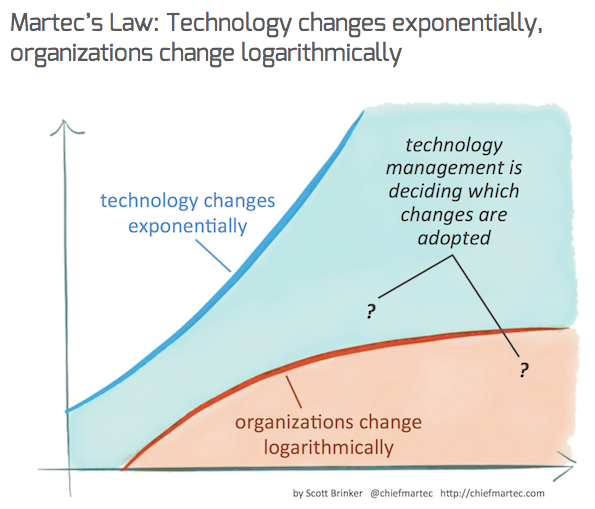
This is a response post to Scott Brinker’s recent post on the gap between how technology changes and how organizations change.  Below you see Martec’s Law.

Martec's Law

Martec’s Law

What’s a logarithm, and is Brinker right?

Now, first of all, this sent me searching for a refresher course on logarithmic functions (Khan Academy has a nice video on the topic).  After thinking about it for awhile, I don’t know if I agree or disagree with Martec’s Law.  I agree that it accurately observes a gap between technology and organizational change. It certainly feels like the pace of change increases while organizations struggle to keep up.

However, recognize that exponential and logarithmic equations are the opposite of one another. Therefore over time (x axis) the curves will move away from one another as the exponential slope increases and the slope of the logarithmic function flattens. This would mean that the gap between technology change and an organizations ability to  respond is widening – dramatically so.

I really struggle with this assertion. One one hand it is true. Things are more complex than they used to be. For example, 50 years ago fixing an automobile was rather straightforward and a home mechanic had a decent shot of fixing problems. Today, automobiles are largely computerized machines. Without the right software and training it’s difficult to troubleshoot and fix an array of automobile sensors and components.  On the other hand, I’ve seen quotes from the 1900s saying that the bicycle is ruining human nature. I’ve seen quotes before that complaining that the printing press is ruining the human condition.  Given a longer date range, it seems to me that Martec’s Law would have produced a situation where organizations are hopelessly lost without a clue of how to harness technology for business.  However, that’s not what I observe. I see some companies that are leading change within their industries. I also see companies that continually struggle to adapt.  Companies that can adapt thrive; those that can’t wither and die.

@iamreff’s Law

For me, whether or not the equations of change are exponential, logarithmic, linear or sinusoidal isn’t important. What’s important is these laws are not immutable and organizations have the ability to improve their ability to adapt to technology change.

[important]

@iamreff’s Law

Organizational adaptivity is not a constant;

organizations can improve their ability to react to technology.

[/important]

Organizations Can Adapt!

Organizations Can Adapt!

Improving Organizational Adaptivity

So organizations can improve their ability to react to technology, how can they do this? Well, I don’t have miles of experience on this topic, but it’s a subject that holds my ongoing interest. I’ve seen two general schools of thought when in comes to activating employees as part of a corporate innovation program:

  1. Dedicate a percentage of all employee time to innovation
  2. Dedicate staff to innovation

Google is a popular example of option #1. They offer employees the ability to dedicate 20% of their time to innovation – although I’ve heard this may not be commonly practiced now that Google is a “grownup company” now. Fidelity is an example of option #2. They have a dedicated lab, FCAT,  focused on emerging technology and even primary research. Which option is best for your organization will depend on a number of factors – you might even use both methods.

Tactically, How do companies drive innovation?

Here are some efforts companies adopt to increase innovation:

  • Data – Build teams to collect, analyze and report data to those that can use it for decision making
  • Crowdsource  – include customers in ideation
  • Empower – involve employees in the innovation process
  • Openness - transparency helps keep the innovation evaluation process free from office politics
  • Testing – test solutions with customers – the results will validate (or challenge) internally held beliefs
  • Results – share results and not just the successes. Companies can learn from their failures too.

These tactics will help drive a culture of innovation. Fully embracing an innovation culture requires an executive champion, likely the CEO – without this support, innovation efforts are likely to stall.

Measuring Innovation?

I believe organizations can drive innovation. One thing I do not know is: How do companies measure their corporate innovation readiness?  Certainly one can measure the results, but is there a way to measure the organization?

Love your thoughts on that.

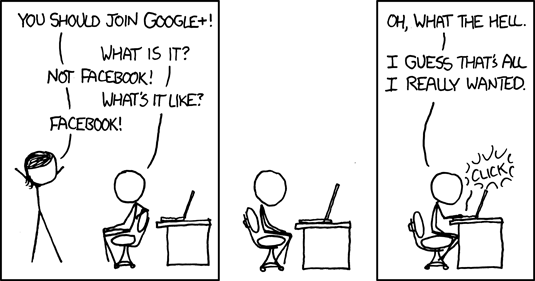
Google+ Hits It Stride

Still ignoring Google+? It’s time for another look. Google+’s features and user experience have always been great. lately what’s really driving my interest is…well it’s better than the alternatives – the Twitter and Facebook social experience continues to degrade.

Source: XKCD

Twitter

What’s wrong with Twitter? It’s gotten junky. It used to be my favorite social network, but my feelings are starting to change. Let’s review the factors that are negatively impacting Twitter’s user experience:

  1. Fake accounts: The number of fake/spam bots on Twitter has grown to an embarrassing level. According to a recent Forbes report, 42% of all accounts are fake, 30% are inactive, leaving only 27% as real people. The level of spam has reached epidemic levels and it greatly devalues the network.
  2. Automation: The ability to automate posting, following increases the amount of noise. Auto direct messages are obviously the worst but in general, so much of the traffic in my feed smells of robots.
  3. Cross posting: On the plus side, most everyone cross-posts to Twitter so it serves as a one-stop-shopping site for what people are sharing. The downside of all this cross posting is Twitter serves as a dumping ground. You’ve likely already seen the content on other sites like Instagram or Facebook.
  4. Brands have taken over: There was a time where people ruled Twitter. Over the past few years, brands have woken up to the opportunities that social media provides. What results is more promotional tweets that, for the most part, make Twitter less social.

Twitter still serves as a great place to get breaking news, but it’s just not as “social” as it used to be.

Facebook

Facebook has had it’s ups and down. Their move to drive revenue has resulted in changes that negatively affect the user experience.  That includes tons of ads and a mobile app that is barely functional.  Nonetheless, I’ve had some of the best internet exchanges on Facebook, so it’s hard to be too down on the service. I even like the chat heads.

Google_másGoogle+

So, finally on to Google+.  As mentioned, Google+ has great features. Examples include:

  1. The website design is well thought out and attractive
  2. The mobile experience is outstanding
  3. Video hangouts
  4. Drag and drop sharing controls (called Circles)
  5. Interest based communities

The features are great but what’s really compelling is it doesn’t have the problems of Facebook and Twitter.

Why Google+ is “more social” than Twitter and Facebook:

  1. No Ads (or better said, no Ads yet)
  2. No fake accounts
  3. Brand messaging does not dominate the platform
  4. Non-writeable API, let’s talk about that more…

Non-writeable API

Sounds super-techie, but what means is you can’t post to Google+ from other applications, if you want to post in Google+ you need to use one of the Google provided interfaces.  The decision to have a non-writeable API has been greatly derided by almost everybody. I was in the audience at SxSWi 2012 when Google’s Vic Gundotra was razzed by the crowd for not opening up Google+’s API.  However, ultimately this decision may be Google+’s saving grace – it’s what keeping the junk off of their social network. As a result the network is clean, usable, valuable and social.

If you use Google+, what you’ll find is quality social interactions. I find the experience much more inline with the orignal ideals of social media – that people can come together to affect positive global change.  In using Google+ you are reminded how “junky” Facebook and Twitter look in comparison.

Google+’s real problem is there are not enough people are there, but there are indications that may be changing.

[important]Circle me at http://gplus.to/iamreff[/important]

Honorable Mentions

Since I’m ranting about social networking platforms, I’ll quickly mention a few others.

Path

The best social networking app <period> If Facebook didn’t exist, this is where you’d be.

Happier

Share your happy thoughts. Uses a simple, yet delightful user interface.

4 Reasons Why Wearable Computers Are OVERHYPED

Iron Man Toon

Ultimate Wearable Computer

I’m Sorry

If you follow me on twitter or instagram you’ll see I share a lot of information pertaining to wearable computers. Specifically the Pebble watch and Google Glass – the first commercially popular examples of wearable computers.  I’m here to tell you that I’m sorry for distracting you with this hype – I can’t help myself – I love this stuff.

But, if I’ve given you the sense that this wearable computers chat is important, well for the vast majority of you – it’s not.  There are four main challenges to broader adoption of wearable computers: interoperability, stigma, etiquette and privacy.

Don’t Believe The Hype

Forbes, Wall Street Journal and NASDAQ all have stories hyping the technologies.

You may be familiar with Gartners Hype Cycle.  Wearable Computers is in the Peak of Inflated Expectations and over the next six months will head into The Trough of Disillusionment - where everyone says “Glass is Dead.” This post focuses on why wearable computers are going to head, quickly, downhill.

Four Factors Stunting The Growth In Wearable Computers

1. Interoperability

I use different apps for different exercise activities: Lose It, Strava, Runkeeper and Everytrail.  It seems like a lot of apps, but they all do specific things that I like. What dont’ they do? Share information.  Wouldn’t it be nice to have all of these devices and apps sharing information in a manner that is useful for the user?  Instead we have API (Application Programming Interface) driven integration system which cares more about profit than usability  The software and hardware manufacturers want to keep you in their app-ecosystem ultimately resulting in a degraded user experience.

Looking at Pebble and Google Glass highlight these problems. The Pebble doesn’t play nicely with the iPhone. Google Glass, while integrated with Google’s empire of web services, doesn’t integrate with much else. There’s no reason to think heavy weights like Google and Apple are going to start playing nicely just so the technology does what you want it to do.

2. Stigma

The Saturday Night Live parody skit goes to show how awkward the user interface is.  Sure, there are early adopters who say “I’ll never take it off,” but the majority of potential customers will never put it on. It’s still too geeky and most people don’t want to be “that guy.”  I can imagine the technology improving over the coming years to be so small it is a lens applied to eyeglasses and maybe even the size of a contact lens. These advancements would remove some of the stigma but further drive problems with etiquette and privacy.

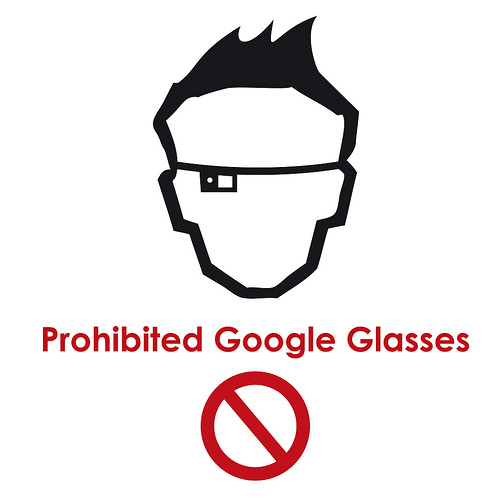
Google Glass Prohibited

Google Glass Prohibited

3. Etiquette

The stigma is about how the user feels, but what about everyone else?  That’s where etiquette comes in.  Recently I was at my daughters dance competition. The organizer had a strict policy against photography, presumably to ward off pervs.  Is the dance competition ready to set policies wearable computers too?  Manufacturers need to show leadership and guide discussions on what is considerate use of the technology. While Google Glass’ photo/video capture commands are easy to spy, “Ok Glass, take a picture,” developers have already broken the verbal cues by creating an app that takes a picture when you blink. This example shows that we need to create etiquette standards for this new technology. We’ve done this in the past for new technologies, think email, but never has the technology had the potential to be so invasive.  Leading us to the final obstacle to wearable computers…

4. Privacy

Without public debate and agreement on how wearable computers should be used, individuals are taking action. A couple of examples:

As computers are shaped to be an extension of our bodies they extend the limits of what humans can do.  Conversations can easily be recorded. Implicit trust is threatened and people will reject and shun the technology.  Using the technology could easily be regarded “poor taste.”  People have reasonable demands to privacy and these expectations will be upheld by etiquette, legislation or ostracizing wearable computers.

In Summary

The Wearable Computing technology trend is fascinating but immature.  Those involved in the movement need to think past the technology and consider the real-world practical implications of how the tech impacts society.  People who don’t give a hoot about wearable computers should recognize the hype and know that there is a system of checks and balances that will integrate this technology into the mainstream in a way that suits the populace.


Photo Credits:

Ironman Toon – DracRoig

Prohibited – Cabrera Luengo

Rudies All Around

My new favorite podcast is Social Pros – “The Show For Real People Doing Real Work In Social Media.” A recent episode of this podcast sparked this blog post.  At 41:00 in the episode, Jay Baer remarked that asynchronous communication (e.g. email and social media) is more efficient and that’s why people use the phone less.

Dorie Clark took it farther, I’m paraphrasing here:

“the phone is used differently now. Unless you have an appointment, it’s considered rude to call someone.  I only talk to someone if I’ve scheduled time to speak with them, likely arranged via email.”

Rudies All AroundPhone Rudeness

The premise “using the phone can be rude” struck me as both absolutely true and not quite right. CONFESSION: I screen my calls. Unless I like know the number, it goes to voicemail. Gawd bless caller ID. I just get too many cold calls from vendors and I like to avoid the awkward dance of them trying to keep me on the phone as long as possible and me trying to get off the phone as quickly as possible.

So what’s not right?

Phones are for sensitive and important conversations when you need to hear not just what is being said but how it’s being said. “are they holding back? do they agree? what are they subconsciously communicating with that pause?“ Using the phone is reserved for important discussions that would be poorly served by a long email chain. In some situations using the phone is hardly rude – it’s required.

Email Rudeness

To be fair, phones aren’t the only digital communication device where rudeness abounds. Do you get unsolicited meeting requests?  I do. Is there anything more presumptuous than taking time on someones calendar without some signal that the person on the other end actually wants to meet with you?  Last week I received an unsolicited meeting invite from a company I respect. The poor soul also made the mistake of cc’ing the recipients, (instead of bcc’ing). What followed was a flurry of reply-all “get me off your list”, “don’t contact me again”, “you’re a dickwad” emails back to the salesman.  So yes, rudeness is not limited to the phone.

Social To The Rescue?

So if cold calling is rude and unsolicited emails are rude, what’s a sales person to do?  Social to the rescue?

Well, it’s more work. It requires finding prospects, evaluating their digital signatures and listening to what the prospects care about.  With prospects identified you then need to find ways to engage them in a conversation.  You can start a conversation by commenting on their blog posts and retweeting their content. These activities build social currency that you can cash in later.

Be nice. Be social. If you’re skillful and helpful, you’ll likely be able to establish a rapport on social channels with the prospect.  If your products and services are useful to the prospect, they will let you know and ask you for more information. That’s when you can connect via email and the phone. 

Seem like a lot of work? It is! It also requires a digital sophistication that many people have not yet fully acquired, but if you want to succeed at selling in a social world, you’ll need to start practicing.

Social Selling

So social is the anti-rude alternative?

Not quite. In general, my experience is people tend to be nice on social media. The exceptions are some websites where comments can get out of hand. And maybe Reddit.

Still there is etiquette to be considered.  Above I laid out how a sales person could best connect with prospects. There’s more to it than that. Like anything being proficient on social media takes practice.  If you’re in sales and you’re not practicing your social media/networking skills you better have plans for an alternative career in the not too distant future. Cold calling is considered rude and your smart competitors are learning how become efficient at social selling. You better get started too Rude Boy!

Still Reading?

Thank you! You may have figured out that this post was simply an opportunity to introduce (or re-introduce) my readers to ska music.  The third wave of ska happened in the ’90s and created some great music.  I’m patiently waiting for the fourth wave of ska – it should be along any moment now.  I’ll leave you with a live performance of Hepcat. Hepcat is a LA based ska band that still plays gigs.  You may recognize Alex Désert from the movie “Swingers”. You can listen to their “Right On Time” album on Spotify.

Photo Credit: I couldn’t determine the original artist; my best guess is it was someone associated with Utah SKA.  I usually don’t use photos without a license, but I made an exception in this case because it was just too delicious.

Load more