“Social Media is where brands act like people and people act like brands.
People acting like brands
Friends can buy you a drink right?
As individuals, social media is used by many as a personal branding platform. Once you become adept at twitter, Google+ or the social network flavor of the day, you’ll see people using social as a stage — a way to tell you about themselves. Those that do it well attract large audiences by providing interesting information, curated content, expert advice and use social networks to have a dialogue. Those that do it poorly are insufferable bores that share trite advice, link to stuff that you’ve already seen and only want to talk about themselves. Etiquette, content and style matter.
Brands acting like people
Brands come at social from a different angle. They realize that they just can’t focus on themselves and their products. In order to attract an audience, they must create and curate content that serves their customers. Brands can’t broadcast on social networks the way they advertise on TV or radio. It’s a different medium with different expectations. They have to adapt their techniques to act more “humanâ€. A great example of this is the Chase Community Giving social campaign. By focusing on philanthropy (not products), Chase has garnered an audience of over 3 million on Facebook. I imagine Chase was already quite generous and by turning their philanthropic efforts into a social campaign they are able to generate a positive affinity for their brand. Tthat they can then work to convert those “likes†into customers.
Yeah, but does it work?
Studies (A, B, C) show that people don’t want to “like†a brand. The idea puts people off. Brands are not my friends, my friends are my friends. However, people who follow brands tend to be strong brand advocates that will promote and defend a brand on social networks.
Marketing Technology Stories you might have missed
MT5 – #13
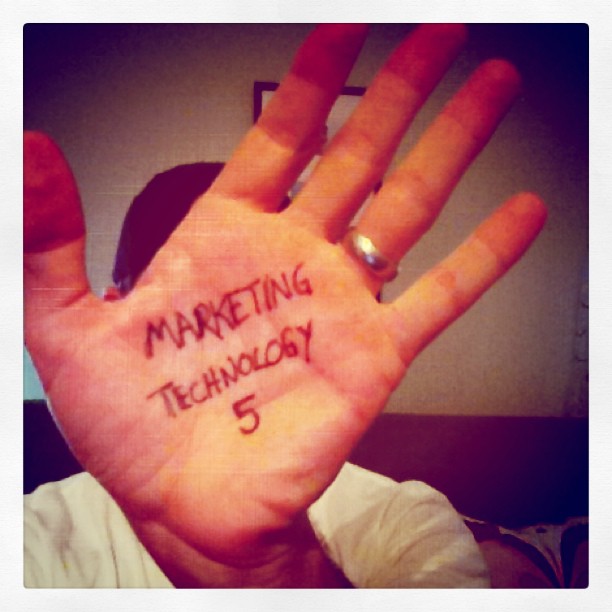
Here are 5 Marketing Technology stories you might have missed. This week: online ads, mobile payments, ebook publishing and Microsoft toys with a new social network.
[link] Microsoft has a research project to test out a social media network it can call its own.
My Take: <sarcasm> Yay! Another social media network! </sarcasm>
2. The future of online advertising
[link] I love this story. It pretty much describes to a “T” how I feel about online advertising. Here are some great quotes:
one of the big reasons why online advertising has done so well is simply the negative one: online micropayments were a disaster, and never took off.
I’ve been looking at ads online for over 15 years now, and I’ve never wanted to click on one
It’s a known fact in advertising circles that only idiots click on ads — and yet advertisers still think that click-through rates mean something, and that a higher click-through rate means a better ad. It’s the measurement fallacy: people tend to think that what they can measure is what they want, just because they can measure it.
its quite astonishing, the degree to which we’ve collectively trained ourselves to ignore ads when we bring up a web page.
My Take: When I had to think about it, Felix is absolutely right. My eyes don’t see online advertisements and if I click on an ad, it was only by accident. The only ads I see are those that run before a video I want to watch – and everyone HATES those ads because they are commercials. So if online spends are a waste do you put all your money in print, TV, radio and outdoor display? Maybe not, check out the next article.
3. Flite – A cloud-based ad platform
[link] Flite provides a ad platform that allows the brand to use different media formats, including social media. The content can be changed in real-time. Click here to see an example.
My Take: This ad platform makes a lot of sense to me. Instead of paying someone do develop a static rich media ad you can buy a branded ad container where you can put in whitepapers, video, social media, etc. You can change the content as you need to and it allows you to integrate your online properties. Sounds pretty smart.
4. Square is tackling payment, publishing and loyalty
[link] Founded by twitter founder Jack Dorsey, Square started as a peer to peer payment app. From there Square is looking to move into other segments of the payment value chain. Square also has “Card Case” which is a payment system between merchants and customers [see video]
My Take: A cardless, cashless payment system seems great. I welcome the innovation, however, to start it looks like it will only be sensible in urban areas with lots of merchants and customers who find value in this disruption. Â I’m expecting this will take a long while to take hold.
[link] You may have read that Amazon is providing new Kindle Fire owners with a trial subscription to Amazon Prime – a value add service that provides free two-day shipping, movie streaming and now a lending library.
My Take: This looks like Amazon is following the Apple playbook of hardware and software integration. [ipod + itunes] [kindle + Amazon store]. With so many options for online reading, I’m wondering how B2B players can best publish their materials to devices like the iPad, Android tablets and kindles.
Here are 5 Marketing Technology stories you might have missed. This FREE BEER edition covers: what’s next in LBS, people love/hate brands on Social Media, privacy management (not as boring as it sounds)…oh yeah, and free beer.
1. Enhance Loyalty Marketing with Location-based Services
[link] Excellent info from the authors of Location Based Services for Dummies. This is no fluff piece, this is where you’ll see LBS and LBM move towards in the next 12-18 months.
My Take: Integration with loyalty programs and passive check-ins could be the trigger that unlocks customers who are sitting on the check-in side lines.
2. What Twitter Users Think About the Brands They Follow
64% follow a brand because they are already a customer of the company—far ahead of the 48% who did so just to get discounts and deals
50% said that after following a company’s tweets they were more likely to purchase from the firm
61% follow brands so they can be the “first to know†what’s hot
28% follow brands so they can curate content and retweet it to their followers
My Take: These are great “presence” stats, meaning they are gauging the effect of a brand just being on twitter. It would be interesting to see how the numbers break down among brands that truly engage with followers and the community versus those that are less engaging in content and style.
3. Less than 1/10 Facebook users like brand pages
[link] Two separate studies report that people don’t want to engage with a brand on Facebook or Twitter.
My Take: When taken together with the previous post it paints an interesting picture. Most people don’t want to engage with a brand on social networks, but those who do tend to be strong, active brand advocates.
4. B2B Marketing: 5 privacy factors to consider when using marketing automation
[link] Rules exist on how to use marketing technology. Especially in the EU.
My Take: If you’re marketing to european customers. You need to be aware of the regulations and the best practices for compliance. Know the rules. Implement your own internal procedures and be transparent with your customers on what your privacy policy is and how you manage their privacy.
5. Why Your Personal Data Is The New Oil
[link]Â Today your personal information is sprinkled across the internet…a personal data vapor trail. Solutions are coming online to help consumers manage their personal information.
My Take: Internet 2.0 runs on personal data. Facebook is free because you are the product. You get to connect with your friends for free because Facebook is using your information to target ads to you. The big question is would personal data vaults hurt or help security?
Free Beer!
If you live in the Deep South of Boston, come out to the British Beer Company this Wednesday for a Jack’s Abby beer tasting charity event. Love to have you there.
GoMo is an initiative that aims to help businesses build mobile-friendly websites. And, in an era when three mobile devices are activated for every baby born on earth, GoMo couldn’t be timelier.
Consider these facts:
Web searches from mobile devices have increased 400% in the last two years.
Soon, more people will access the web from a mobile device than desktop computers.
Businesses can increase consumer engagement up to 85% with a mobile-optimized website.
But in spite of these compelling statistics, only 36% of American businesses have mobile friendly sites. Everyone else is missing out on a huge opportunity to reach customers in a new and very personal way.
As advertising professionals, this is exactly the kind of opportunity we should jump on. A campaign without a mobile strategy is really just not a complete campaign anymore. This is as rich and as crucial a field to be playing in as the internet itself was 15 years ago, and the time to do it is now.
And that’s where GoMo comes in. Visit the case study section of GoMo to learn more about how consumers use mobile and understand best practices for mobile sites. You can even run your site through the GoMoMeter for a personalized report on how to get mobile-friendly. Get smart about mobile, and get ready for a revolution in digital creative.
Here are 5 Marketing Technology stories you might have missed. Hot Topics this week:mobile app dev, GoMo, Mom’s rule and integrating email and social.
1. Report: iOS and Android apps fighting for retention, not discovery
[link] Great report on the state of mobile app development.
In summary:
Android is catching up to iOS in terms of quantity of apps
The number of monthly downloads has quadrupled in a year
Retention is replacing app discovery as the number 1 problem
My Take: No surprise – quality content still wins. Mobile app developers can pay their way to a high ranking in app stores, but if the app doesn’t kill, it will quickly drop in the rankings.
2. How To Go Mobile with Google
[link] Google launched a microsite that helps companies mobilize their website
provides free tools: in this case it rates your current website’s look/feel and functionality
provides free advice: why site mobility matters
It provides a clear call to action: companies that you can work with to mobilize your site
My Take: Why did Google do this? Perhaps it has a revenue sharing agreement with the companies that it provides but I imagine that will be peanuts to Google. I suspect the real reason is the lack of mobile sites will impede Google’s future ability to sell mobile ad space. HowToGoMo.com helps fill that gap.
3. Mom’s Rule
Getting to Know (and Like) the Social Mom
[link] This Nielsen report shows the purchasing power of social moms. They are much more likely to share product experiences online.
Mom Bloggers, A Force To Be Reckoned With
[link] This Scarborough report shows that Mommy bloggers are “Not just media users, they’re media makers”
My Take: These articles, along with being married to a mom that works in this space, highlights the influence power of social moms. They have a strong voice, they’re super-social and well organized. Smart brands already know this and include them in their social campaigns.
4. Interactive Email: 6 tactics to leverage the influence of social reinforcement
[link] Marketing Sherpa provides great detail on how to integrate social into your traditional email marketing campaigns.
My Take: I suspect Marketers are realizing email and social aren’t “either / or” propositions. Figuring out how to integrate traditional and social marketing is key and you’ve got to love this level of detail.
5. Google Revamps AdWords Location Targeting Tool
[link] Google is integrating Google Maps with AdWords. The first of these changes provides a graphical interface and more information such as reach.
My Take: PPC isn’t my thing, I suspect this is a minor update. It is also consist with the general theme of product integration and rationalization Google has undertaken.
GoMo is an initiative that aims to help businesses build mobile-friendly websites. And, in an era when three mobile devices are activated for every baby born on earth, GoMo couldn’t be timelier.
Consider these facts:
Web searches from mobile devices have increased 400% in the last two years.
Soon, more people will access the web from a mobile device than desktop computers.
Businesses can increase consumer engagement up to 85% with a mobile-optimized website.
But in spite of these compelling statistics, only 36% of American businesses have mobile friendly sites. Everyone else is missing out on a huge opportunity to reach customers in a new and very personal way.
As advertising professionals, this is exactly the kind of opportunity we should jump on. A campaign without a mobile strategy is really just not a complete campaign anymore. This is as rich and as crucial a field to be playing in as the internet itself was 15 years ago, and the time to do it is now.
And that’s where GoMo comes in. Visit the case study section of GoMo to learn more about how consumers use mobile and understand best practices for mobile sites. You can even run your site through the GoMoMeter for a personalized report on how to get mobile-friendly. Get smart about mobile, and get ready for a revolution in digital creative.